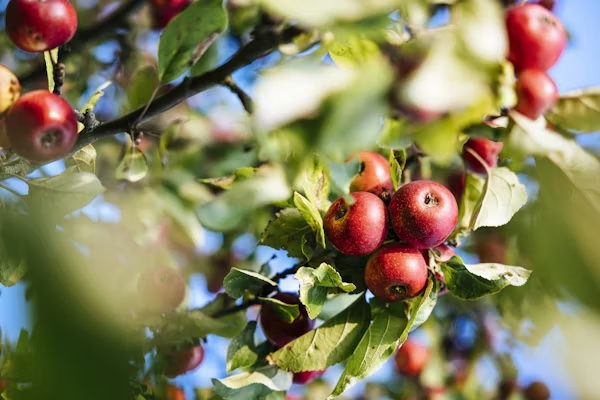
Small gardens force practical decisions. Every square metre has to justify itself, especially when planting something permanent. That is why stepover apples deserve more attention than they usually get. They offer fruit, structure and ease of management without taking over the plot. For households that want an edible garden but do not have room for a standard tree, they solve several problems at once.
The fruit trees specialists at Fruit-Trees nursery say that many gardeners underestimate how effective low-trained apple forms can be in tight spaces. In their view, gardeners who want to buy stepover apple trees are often looking for more than a novelty; they are trying to fit productive fruit growing into a modern garden where borders, paths, seating and fences already compete for space. A stepover, when properly chosen and maintained, can do that job with less compromise than larger forms.
What a stepover apple actually is, and why it suits modern plots
A stepover apple is a very low-trained tree, usually formed with a short trunk and a single horizontal tier of branches held close to the ground. It is sometimes described as the smallest formal trained apple tree, but that does not mean it is merely decorative. Its real strength is that it combines fruit production with a footprint that is unusually modest. In gardens where a bush tree would block light, or where a fan or espalier needs a wall, the stepover can fit into spaces that would otherwise remain ornamental or unused.
This matters because the shape of a fruit tree often determines whether it works in an ordinary garden. A standard tree can dominate a lawn. Even a half-standard may cast too much shade over borders or require more pruning than a casual gardener expects. Cordons are useful, but they tend to suit people willing to follow a fairly disciplined pruning routine. Stepovers sit in a helpful middle ground. They are formal enough to stay compact, but simple enough to understand at a glance.
In British gardens, where many properties have narrower back gardens than older fruit-growing advice assumes, this low profile is more than a curiosity. It allows fruit to be grown along the edge of a path, beside a vegetable bed, or as a dividing line between one area and another. It also keeps picking and pruning at ground level, which removes one of the common barriers to growing apples at home.
There is also a visual advantage. Because the structure is clean and restrained, a stepover can make a small garden look more organised rather than more crowded. That is not always true of larger fruit trees, which can seem bulky in a confined setting. A stepover provides a clear line, and in winter that line has as much value as the fruit itself. For gardeners trying to make a compact garden feel deliberate, not cluttered, that is a serious benefit.
Reason one: they make productive use of space that usually goes to waste
The strongest case for stepovers is simple: they occupy space that many gardens fail to use well. The strip beside a path, the front edge of a border, the margin beside a patio, or the line between lawn and vegetable patch often remains empty because it seems too narrow for meaningful planting. A stepover turns that strip into a fruit-bearing feature.
This is especially useful in smaller suburban gardens, where width is often the main limitation. A tree that spreads in all directions creates conflict with neighbouring plants, mowing access, seating areas and sightlines. A stepover grows in a controlled horizontal line, which means it can define space without swallowing it. In effect, it behaves more like a living edging than a conventional orchard tree.
That layout can also improve the wider garden plan. Instead of reserving one corner for fruit and another for flowers, the gardener can integrate both. A stepover can run in front of herbaceous planting without heavily shading it. It can separate a kitchen garden from the rest of the garden without the hard feel of a fence. It can even sit in a formal front garden if the aim is to combine neatness with food production.
The productivity of that narrow footprint is what surprises many people. No one should expect the crop of a mature orchard tree, but that is the wrong comparison. The relevant comparison is with what would otherwise occupy the same area. A low apple trained along a single tier may produce a worthwhile crop from a strip that could otherwise hold only edging plants or bare soil. In a small garden, efficient use of awkward space is often more important than maximum yield per tree.
This is one reason interest continues among gardeners who want to grow more food without redesigning the whole plot. When people look to buy stepover apple trees, they are often responding to a layout problem rather than simply choosing an unusual form. The stepover is a spatial answer first and a stylistic one second, and that is precisely why it earns its place.
Reason two: they are easier to manage than many gardeners expect
Fruit growing often falls apart at the maintenance stage. The initial purchase is exciting, but the long-term success of a tree depends on whether the owner can realistically prune it, inspect it, feed it and harvest it every year. In small gardens, where plants are close together and access matters, easy management is not a luxury. It is the difference between a tree that stays useful and one that becomes a nuisance.
Stepovers have a clear advantage here because almost all routine work happens within easy reach. There is no need for ladders, and little chance of fruit disappearing into an inaccessible upper canopy. That sounds minor until the tree enters regular cropping. Many people are happy to pick apples when they can see and reach them. They are much less enthusiastic when fruit requires balancing on steps or stretching through dense growth.
Pruning is also simpler because the shape is obvious. The gardener is not trying to interpret a large three-dimensional crown. Instead, the aim is to maintain the low horizontal framework and manage new shoots so the form stays balanced and fruitful. A trained tree still needs attention, but the task is more readable. For beginners, that makes a significant difference. The structure itself teaches the pruning logic.
Pest and disease checks are more straightforward too. Apples in British gardens can face the usual issues of aphids, woolly aphid, scab, canker, codling moth and mildew, depending on variety, site and season. Spotting a problem early is easier when the entire tree sits at a convenient height and is not hidden behind a mass of top growth. Better visibility often leads to better decisions, whether that means improving air flow, removing affected material or choosing a more resistant replacement in future.
Watering and mulching are equally manageable because the planting area is concentrated and accessible. In the establishment years, that can improve survival and early growth. For busy households, practical convenience matters. A tree that asks for modest, understandable care is far more likely to be maintained properly than one that always feels like a specialist project.
Reason three: they help small gardens stay open, light and usable
One of the hidden costs of planting the wrong fruit tree in a small garden is the loss of openness. Gardens feel smaller when the eye hits a solid mass of branches in the middle distance. Light levels drop, underplanting weakens, and outdoor seating can become shaded at the wrong time of day. A productive garden should not come at the cost of making the whole plot feel enclosed.
This is where the stepover’s height works in its favour. Because the trained framework sits low, it does not interrupt the wider sense of space in the same way as a bush or half-standard. Views remain open across the garden, which helps a modest plot feel larger than it is. In practical terms, this means a family can grow apples without surrendering the visual breadth that makes a garden pleasant to use.
The light issue matters just as much. Many small gardens already face compromises from fences, sheds, neighbouring buildings or established shrubs. Adding a broad-canopied fruit tree can worsen those conditions. A stepover leaves more sunlight available for nearby beds, especially during the main growing season. Gardeners trying to combine apples with vegetables, herbs or sun-loving perennials often find that this low-trained form allows a more mixed planting scheme.
Usability improves as well. A garden is not only a place for plants; it is also a route to the shed, a place to sit, an area for children, and often the setting for drying washing or storing bins. A fruit tree that pushes into those functions soon becomes frustrating. The stepover’s disciplined line keeps the tree legible within daily life. It can mark an edge without blocking movement, and it can soften a boundary without becoming one.
There is a design lesson here. Small gardens benefit when structure is low, clear and repeated. Stepovers fit that principle. One tree can act as a feature, but a short run of two or three can create rhythm and order. In modern British gardens, where people often want both utility and neatness, that balance is increasingly relevant. The tree earns its place not only by fruiting, but by preserving the garden’s wider usefulness.
Reason four: they make home-grown apples more realistic for beginners
A great deal of fruit-growing advice still assumes an enthusiast prepared to learn pruning systems in detail, monitor rootstocks carefully and manage a dedicated fruit area with patience over many years. That approach has value, but it is not the only route into growing apples. Many gardeners want a more approachable entry point. They are willing to care for a tree, but they do not want the process to feel like taking on a second hobby.
Stepovers are often a better starting point than larger forms because their scale reduces the consequences of mistakes. A missed summer prune or an overenthusiastic cut is easier to recover from on a compact, clearly trained tree than on a vigorous, loosely managed specimen. This does not make them maintenance-free, but it does make them forgiving enough for ordinary gardeners.
That accessibility matters for confidence. Success in the first few years usually determines whether someone continues with fruit growing. If the tree becomes too large, fruits poorly, or proves difficult to shape, enthusiasm fades. A stepover offers early wins: the form is understandable, the work is reachable, and the fruit is visible. Gardeners can see the relationship between pruning, flowering and cropping more easily than on a taller tree with hidden growth.
There is also less psychological resistance to harvesting. People are much more likely to pick fruit promptly when it is in plain sight and easy to reach. That helps with quality. Apples left too long can drop, bruise or attract wasps, while fruit picked at the right stage is more useful in the kitchen and stores better where the variety allows it. A manageable tree encourages timely action.
For households with children or older gardeners, the low structure has an obvious appeal. It brings the crop within reach without turning the tree into a hazard. That can make fruit growing feel more inclusive and less technical. In an era when many people want edible planting but have limited time and space, beginner-friendly forms deserve more attention. The stepover is not merely a training style from old manuals; it is a practical answer to how people actually garden now.
Reason five: they combine ornament and utility without pretending to be one or the other
Many small-garden choices fail because they try too hard to be either purely decorative or purely productive. A plant chosen only for looks may not justify precious space. A plant chosen only for yield may look awkward or overbearing in a domestic setting. Stepovers succeed because they do both jobs honestly. They are useful trees with a distinctly orderly appearance, and that combination is rare.
In spring, blossom is carried along a low horizontal line that reads clearly from a distance. In summer, the developing fruit gives the structure purpose. In autumn, the harvest itself becomes part of the display. In winter, the bare framework still contributes shape. That four-season value matters in a small garden, where every permanent planting should ideally do more than one thing.
The ornamental quality is not elaborate. Stepovers are attractive because they are disciplined. Their form suits both traditional and contemporary settings, and they can sit comfortably alongside roses, herbs, gravel paths or clipped edging. They do not demand a cottage garden, nor do they require a formal parterre. Their neutrality is part of their usefulness.
At the same time, the utility is genuine. This is not a token edible tucked into a flower bed for effect. A well-chosen variety on an appropriate rootstock, grown in a sunny open position and pollinated properly, can provide a very decent crop for household use. The key is to match expectations to the scale of the tree. A stepover is not meant to replace a full orchard tree. It is meant to make apple growing possible where a larger tree would be impractical.
That distinction should guide buying decisions. Variety choice, rootstock, pollination group and site conditions still matter. So do aftercare, soil preparation and annual pruning. But when those basics are respected, the stepover justifies itself in a way few small-space fruit forms can. It gives structure, fruit, manageability and visual order in one compact package.
For British gardeners dealing with shorter plots, tighter boundaries and a growing interest in edible planting, that is a persuasive set of advantages. The stepover is not the answer to every fruit-growing situation, but it is one of the clearest answers to the small-garden problem. That is why it deserves to be seen not as a novelty, but as one of the most practical apple tree forms available.